


The SUFE Investment Dept. 2017 Series of Academic Reports Period 7-9
On the afternoon of March 31, 2017, the SPEA Investment Dept. 2017 First Expert Report was successfully held in Room 304 of phoenix building in Wuchuan Campus of SUFE.
In this Expert Report, Professor Zhou Jingkui from Nankai Institute Of Economics, Professor Kuang Weida from Dept. Of Finance of Business School of Renming University of China, and Doctor Liu Zhi, Dean of Center for Urban Development and Land Policy of Peking University -Lincoln Institute, gave lectures on China Urban Family Housing Consumption and Its Determinants Analysis, Does Corruption have Impact on China’s Land Transfer Efficiency, and China Urban Fiscal Issues on Sustainable Development respectively. SPEA Investment Dept. Dean Professor Chen Jie planed and presided this Expert Report.
Fellow of the British Academy of Social Sciences and Chair Professor in University College of London (UCL) Professor Wu Fulong, President of Homelink Research Institute Doctor Yang Xianling, Teachers from Shanghai Normal University and other Shanghai Universities, and SPEA Department of Public Finance Professor Fan Ziying, Department of Public Administration Associate Professor Li Huiping, China Public Finance Institute Doctor Zhang Muyang, Department of Investment Associate Professor Ma Zuqi, Doctor Zong Qingqing, Doctor Deng Xiaoying and other teachers and students attended the Report.
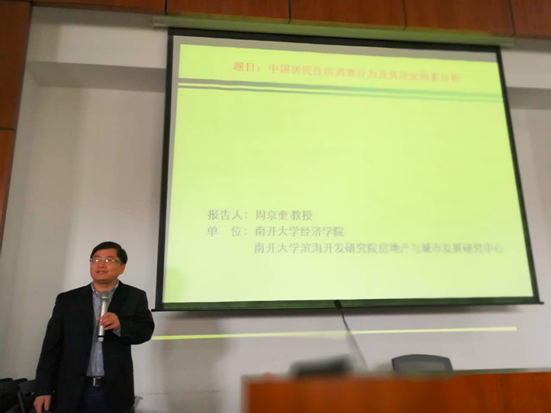
In the first lecture, Nankai Institute of Economics Professor Zhou Jingkui systematically introduced the 2015 CHCS collected by Nankai University, and pointed out that, the housing consumption development reflected housing welfare level and market development trend, having profound meaning. Based on the statistics, they studied China Housing Consumption Decision Factors and reached conclusion that, the rigid demand is still the major demand in current China Urban Housing Consumption, and the investment property is weaker than its consumption property; housing consumption appeared U-structure with age, and presented inter-generational mutual help. What’s more, the study expects that the two-child policy would lead to a new round increase in rigid demand of housing.
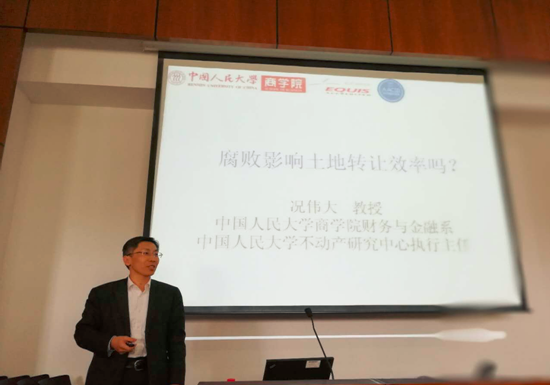
In the second lecture, Professor Kuang Weida from Business School of Renmin University of China introduced the background of his paper Does Corruption have Impact on China’s Land Transfer Efficiency: the one is that the impact of corruption is not decided, and the other is that, since 2002, competitive land transfer policy has been implemented in China Land Market, which provided as a nature laboratory to examine the impact corruption has on government land transfer efficiency. Based on the background, he studied the statistics of corruption and land transfer in 35 China Big Cities during 2003 to 2013, and found that corruption has positive impact on approved selling, but negative impact on land listing, biding, and auction. The paper used instrumental variable of corruption and the empirical result is still remarkable. The conclusion is that corruption is harm to land transfer efficiency.
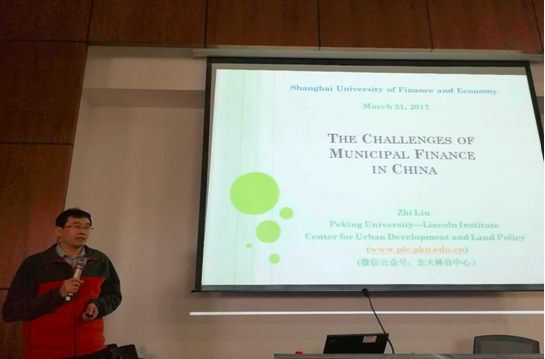
In the last lecture, Dean of Lincoln Land Center of Peking University Doctor Liu Zhi shared on China Urban Fiscal Issues on Sustainable Development, he pointed out that the position of China Urban Pubic Finance is more and more important with the deepen of urbanization. In recent 20 years, China cities, relied on land finance, fast promoted urban development and infrastructural construction, and brought some social economic and environmental problems. With the role decline of land finance, China cities need establish new fiscal income and financing channel. He further discussed the sustainable development issues and possible solutions.
During the lectures, speakers responded to the questions raised by the audience at any time, and had heated communication and discussion.
At the end of the Report, the host Professor Chen Jie summarized the Expert Report, extended gratitude for the excellent lectures of the three speakers, wished more support and attention on discipline construction and academic research, and welcomed more experts embarked on the academic stage of SUFE Investment Dept. to share wisdom and insights. The Report ended successfully.
ZHOU Jingkui is Professor and PhD Supervisor in Nankai Institute of Economics and his research area is Real Estate Economics, Urban Economics Theory and Practice, Industry Transformation and Economy Growth. He is currently Dean of Real Estate and Urban Development Research Center of Nankai Institute of Binhai Development, Director of China Association of Real Estate Academician, Director of Global Chinese Real Estate Congress, Director of Bohai Economic Associate, and visiting scholar of UCLA. He published more than 50 essays in China Economic Review, Economic Modeling, Economic Research Journal, China Economic Quarterly, Journal of World Economy, Journal of Financial Research, host one Key Program of National Social Science Fund, one Key Program of Ministry of Education Humanity and Social Science Research Base, two China Programs of Lincoln Institute of Land Policy, and honored Second Prize of the 15 th China Humanities and Social Science Excellent Achievement, Third Prize of the 12 th Tianjin Social Science Excellent Achievement, First Prize of the 11 th Tianjin Social Science Excellent Achievement, Third Prize of the 10 th Tianjin Social Science Excellent Achievement.
Professor KUANG Weida is Professor and PhD Supervisor of Renmin University of China, Executive Director of Institute for Real Estate Research, and Director of Asian Real Estate Association. He received Master degree from China Agricultural University in 1999 and PhD from Renmin University of China in 2002. He joined Institute of Public Finance and Trade of China Academy of Social Science in 2002 and joined School of Business of Renmin University of China. His research area is Real Estate Finance, Real Estate Economics, and Urban Economics. He published more than 30 essays in International Real Estate Review, International Journal of Housing Markets and Analysis, Journal of Economic Research, Journal of World Economy, Journal of Financial Research, and he received 2012 Best Essay of Asian Real Estate Association, and selected in Program for New Century Excellent Talents by Ministry of Education. He host National Nature Science Fund Programs Interest Change, Loan Discrimination and Mortgage Risk, House Price Fluctuation and Mortgage Default Risk, The Influence of Property Tax on Property Prices, and published books Real Estate and China’s Macro Economy and Monopoly, Competition and Regulation--Study on Market Structure of Housing Industry in Beijing.
Doctor LIU Zhi, Bachelor of Zhongshan University, Master of Nanjing University, Doctor of Harvard University, is currently Dean of Center for Urban Development and Land Policy of Peking University -Lincoln Institute and Member of 13 th Five-plan Expert Committee of National Development and Reform Commission. He was Chief Infrastructure Expert in East Asia and Pacific Region Sustainable Development Bureau of World Bank. He participated Urban transportation and Urban Economic research of America, Korea and Chile when he worked in Harvard International Center of Development during 1994 to 1995. He joined world bank in 1995 and focused on Loan Business of transportation and urban development department and industrial policy study. He took dean of southeast Asia Countries Infrastructure department, and presided the research on China’s Urban Transportation Policy, Indian Transportation Department Development, Cambodian Energy Development, Thailand’s Transportation Energy Consumption as well as urban development, transportation and poverty alleviation, globalization, transportation economy analysis, infrastructure construction and investment and financing, urban fiscal and published related essays. He took vice chairman of Global Transportation Future Problems Congress of the World Economy Forum in 2009.