


On the afternoon of Sept. 19, 2017, SPEA Investment Department 2017 Autumn Semester First Academic Report was successfully held in room 502 in phoenix building. The forum aims to improve our academic atmosphere, promote academic exchange and mutual understanding, strengthen PhD student training, perfect internal academic exchange platform, and elevate our academic level. This Forum was hosted by SPEA investment department Director Professor Chen Jie, while SPEA Party Secretary Fang Fang, Deputy Dean Fu Wenlin, public administration department Associate Professor Li Huiping, investment department Associate Professor Yang Ye, Associate Professor Gao Xiaohui, Associate Professor Ma Zuqi, Lecturer Ye Fang, Assistant Professor Deng Xiaoying, Lecturer Guo Feng, Lecturer Deng Kuangkuang, and more than 20 PhD students attended this forum.
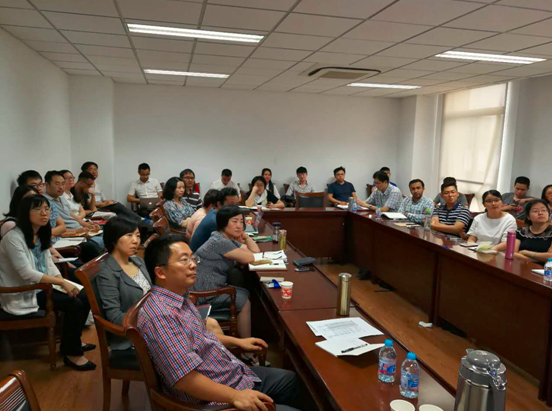
SPEA Teachers and Students attend the 2017 Autumn Semester First Academic Report
We have three new teachers and one PhD student giving academic reports. First, Deng Kuangkuang , the newly introduced lecturer and PhD from Hong Kong University, shared on Revisiting the autocorrelation of real estate returns. The paper takes Hong Kong real estate market as an example to analyze two autocorrelation models of real estate returns. She finds that, the pricing deviation in real estate trading will bring negative deviation, while the speed of regional price reverse adjustment is limited, and regional sub-market returns reflect the negative autocorrelation. Meanwhile, the autocorrelation of whole market is higher than that of regional market, which is caused by the regional difference of trading cost. In such circumstance, the remarkable autocorrelation of real estate returns are not certainly linked to the profits in real estate market. During the report, presented teachers promoted some feasible revise suggestions on sample selection, model construction, data processing, interpretation of empirical result, and model implementation.
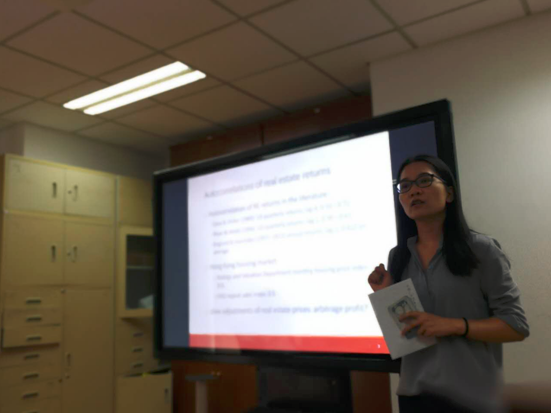
Investment Dept. Lecturer Dr. Deng Kuangkuang gives report
Then, Deng Xiaoying, the newly introduced lecturer and PhD from National University of Singapore, shared on Urban Land Sale Revenue and the Supply of Affordable Housing: The Case of China. The sparks of thought of this paper comes from the social quasi experiment of Singapore ancestral houses. Then, she tries to discuss the housing problem in China through theoretical model and empirical analysis. The paper, based on the aim of maximizing social welfare, constructed a theoretical model containing commercial house and security house, and assumed that commercial houses are only provided by market while security houses are provided by market and government. She finds that, there are more security houses in the regions where land transferring fees are higher. The empirical analysis further proved the viewpoint. During the report, they have had heated discuss. Presented teachers communicated on problem selection, social welfare function construction, and empirical analysis feasibility.
Then, Guo Feng, the newly introduced lecturer, PhD from Fudan University and Post-doctor from Peking University, shared on Citation Trap of Papers Published at Year-End: Evidence from Economics SSCI Papers during 1956-2010. The paper based on WoS data during 1965 to 2010, explores the influence of paper published at year-end on citation through empirical analysis. He finds that, the citation rate of paper published during Oct. to Dec., is 18.8% lower than that of paper published on other months in the same year, and is 6.2% lower than that of paper published on other months in the next year. And the citation trap is more remarkable in web searching and in non-top journals. Presented teachers discussed with lecturer and promoted some revise suggestions on entry point, dependent variable and proxy variable selection, and control variable selection.
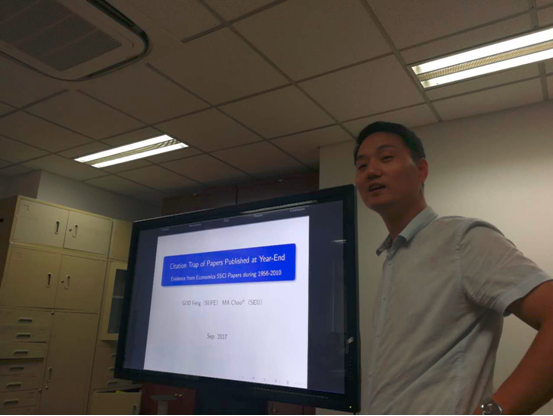
Investment Dept. Lecturer Dr. Guo Feng gives report
The fourth reporter is Zhong Shihu, 2017 PhD student in real estate economics and his paper subjected on Research on the Evolutionary Logic and Economic Effect of Economy Financialization. The paper, instructed by professor Chen Jie, aims to build a economic model with three sectors, explores internal logic of economy financialization through division perspective, reveals the function of economy financialization on economic development, and defines critical condition of excessive financialization. He finds that, economy financialization will expand product division. However, only when trading cost parameter and the fixed learning cost parameter of financial service production are lower than some threshold value, economy financialization will come into being. The economy financialization has self-enhancement effect, and it will further lower trading cost and financial service fixed learning cost, which will further enhance itself. The economy financialization has two sides to national economy. When the professional economic degree and circuitous economic degree are high, economy financialization has positive effect to improve labor productivity, market scale and real income per person, while it has negative effect when the degrees are low. Presented teachers discussed with lecturer and promoted some revise suggestions on function selection, exogenous parameters definition, and solution of the model.
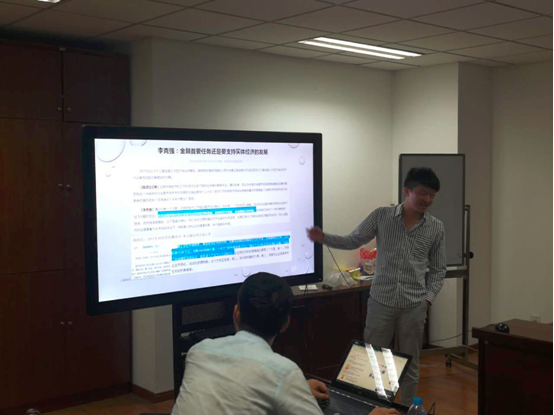
2017 Real Estate Economics PhD Student Zhong Shihu gives report
In the end, the host Professor Chen Jie announced the successful closing of this academic forum, and extended his gratitude to the support and participant of teachers and students. This forum is another collective academic exchange activity hosted by investment department since the PhD Forum during Nov. 2016 to Jan. 2017. This Academic Forum, improved our academic atmosphere, promoted academic exchange and mutual understanding, strengthened lecturing ability of PhD students, and received good feedback from teachers and students.
Article: Zhong Shihu Review: Chen Jie