


At 14:00 on June 22, 2017, Party committee of School of Accountancy and Party committee of School of Public Economics and Administration jointly held a Party Lecture on Lecture Hall 108 of School of Accountancy in Wudong Campus. Shanghai Federation of Social Science Associations Leading Party Group Vice Secretary Professor Sang Yucheng was invited as the Speaker, and the theme of lecture is Ideological Challenges and Working Path Selection in Colleges. Nearly 50 party members from the two schools attended the lecture.
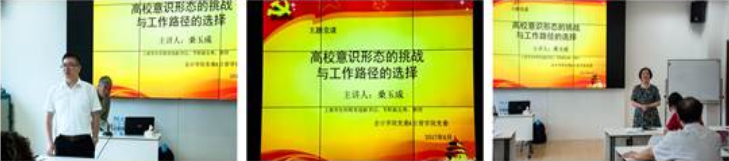
Professor Sang said, College ideological education work has been attached great importance in recent years, and gain more and more attention with the development of economics and society. For a long time, College ideological education work relies on three forces: the first is professional teachers in School of Marxism, the second is the large counsellor team, and the third is the team in propaganda system. However, ideological education work is a sophisticated and systematical project, and the three forces are far from enough. We should further enlarge the work team, promote teaching ideology rather than ideological course, which means teachers integrated ideological education into teaching process and makes college both the academic palace and the ideological highland.
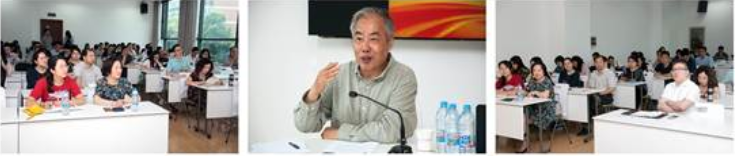
Then, Professor Sang analyzed three profound social factors contributing to the importance of college ideological education work. The first is that, in the end of 80s and beginning of 90s of last century, the Soviet Union collapsed and Eastern Europe upheaval, the international socialist cause suffered setbacks, which brought great challenge to ideological education. The second is that, with globalization and informatization, college students have multiple channels to receive information, which brought great challenge to ideological education with foreign ideas shock. The third is that, the transformation of our society brought employment pressure and life pressure, which inevitably brought influence to students’ ideas.

In the end, Professor Sang, combined his years’ teaching and research experience, promoted eight principles on further improve the efficiency and effect of college ideological education work. The eight principles are focusing principle, compatibility principle, subjectivity principle, qualification recognition principle, selectivity principle, knowledge guide principle, differential treatment principle and stimulation reaction principle. Professor Sang shared vivid cases to demonstrated the application of these principles in teaching processes, which benefited the attendees a lot. During the interaction section, Fu Chun, from SPEA party committee, discussed on the education model of minority nationality students. She talked that, the eight principles answered her doubts in the teaching work. After the lecture, some of the party members also shared their feelings and experience in the ideological education work with Professor Sang. This lecture, enlightened the party members, and made contribution to further improve college ideological education work in the new situation.
Article: Zhang Yao(Ph.D) Photo: Wang Bin Review: Wang Bin