


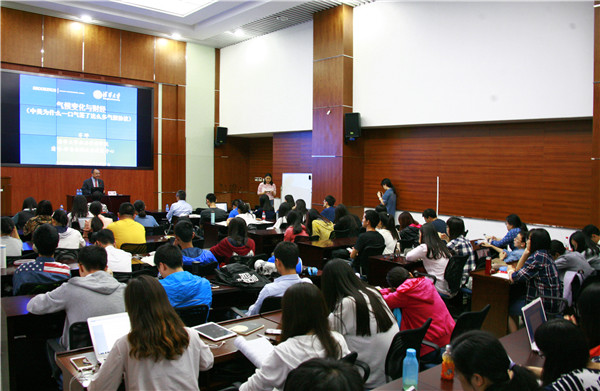
On the evening of May 27th, Tsinghua University’s professor Qi Ye was invited to come “Science and Humanity Forum” of our university and brought a special subject lecture on “Climate Change and Finance and Economics– Why Did China and the United States Sign So Many Climate Agreements”. The lecture took place in room 302 of Phoenix Building and more than 120 teachers and students attended.
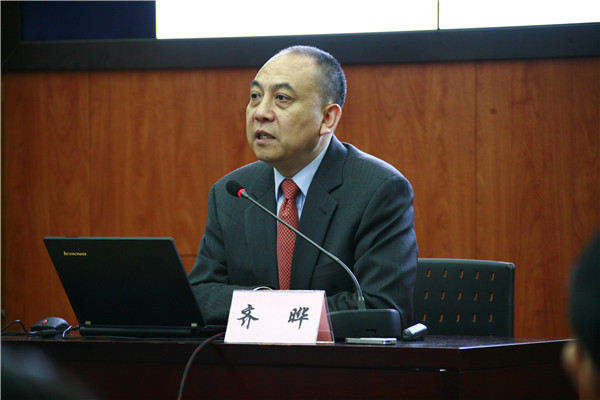
Prof. Qi Ye is a well-known expert on China’s environmental policy, the director of the Tsinghua-Brookings Public Policy Research Center, a Changjiang Scholar in environmental policy of Tsinghua University’s School of Public Policy and Management, and a member of the Academic Degrees Committee of the State Council. In 1994, he received the environmental science doctorate from the School of Environmental Science and Forestry Science of State University of New York and Syracuse University, then he completed his postdoctoral research at University of California, San Diego. From 1996 to 2003, he taught at the Department of Environmental Science, Policy and Management at the University of California, Berkeley. In 2001, he was selected as a Distinguished Professor of Changjiang Scholars Program which was founded by the Ministry of Education and Li Ka-shing Foundation. In 2004, he was selected as a Distinguished Professor in the “100-Talent Program” of Tsinghua University. Prof. Qi Ye has a large number of writings, and worked as the reviewer for many international journals including Science, Nature and Proceedings of the National Academy of Sciences and so on. His research focuses on China’s climate change, environment, energy, natural resources and urbanization policies.
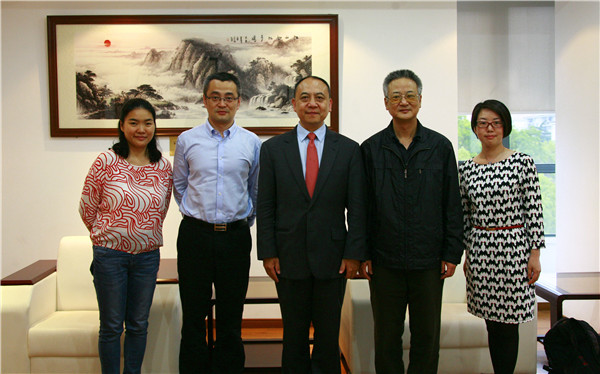
Before the lecture, Liu Yongzhang, Deputy Secretary ofParty Committee of SUFE, held talks with Prof. Qi Ye, expressed thanks for Prof. Qi Ye’s lecture, and made a brief introduction of the history and the status quo of our university. Prof. Qi said he was very happy to have communications with the teachers and students of SUFE. Mr. Shen Hui, Secretary of General Party Branch of SPEA and Miss. Fang Hui, Deputy Secretary of General Party Branch of SPEA accompanied the talks.
Prof. Qi Ye shared some basic concepts on climate change firstly through the topic of the four-time signings of The China-U.S. Climate Agreement, and introduced the current ten-point consensus on climate change, the current climate situation, the financial and technological difficulties we faced, and the process of international response to climate change and so on. He pointed out that the essence of international negotiations on climate change is the issue of right to use fossil fuels and the international distribution of emission space.
Subsequently, Prof. Qi gave a further elaboration on climate change issues from three perspectives of game, cooperation and politics, and made a detailed description of the Sino-US game and cooperation of climate change. In the face of the earth problems caused by climate change, countries strive to maximize their own interests that lead to no progress of global response to climate change. In the situation of that the cooperation mechanism has not been established and all parties choose non-cooperative game, the Sino-US leaders hold conferences four times and sign four relevant agreements of climate governance. The Sino-US cooperation on climate change plays a global leadership. So, why does China stand up? Prof. Qi made a detailed analysis on the climate-related domestic reality from the aspects of moral responsibility, domestic demand, new outlook, energy and economic strategy, global governance, etc. He believed that China’s role in global response to climate change is becoming more active and more prominent, and he was looking forward to China’s showing more powerful global leadership and becoming the leader of emerging climate change.
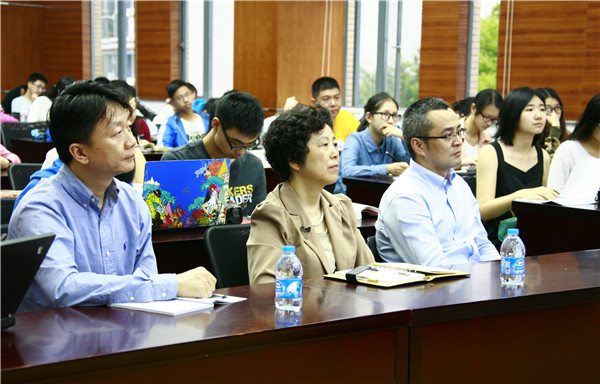
Finally, Prof. Qi introduced the overall implementation of the climate strategy briefly combined with the analysis of the main objectives of China’s economic and social development during the 13th Five-Year Plan period and the unprecedented opportunities for green development in China. At the end of the lecture, Prof. Qi had a lively interaction with the teachers and students.

Through detailed data and vivid cases, Prof. Qi Ye explained the profound theories in simple terms and a humorous way, and brought a wonderful lecture for our teachers and students, which helped teachers and students to have a more comprehensive, in-depth and thorough understanding on climate change, especially on the question that why China and the United States have sighed so many climate agreements.